Retail
Printed corrugate displays for cosmetics merchandising
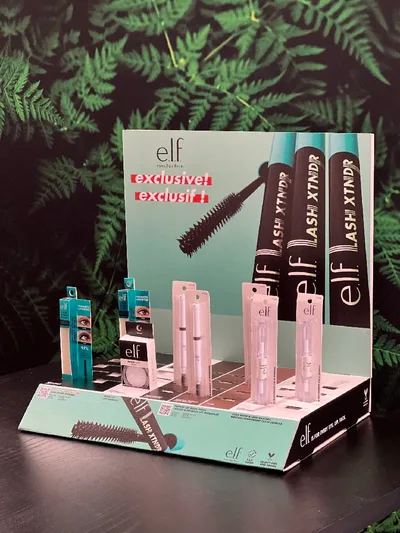
A range of corrugate displays produced for e.l.f. Cosmetics. Cosmetics merchandising asks a lot of cardboard: a large number of small, dense products, held in a defined planogram, on a unit that has to travel flat, build fast and stay square while it is being shopped.
What the job demanded
Cosmetics displays hold small items with a surprising amount of weight per shelf, and they are shopped constantly, so product is lifted out and put back all day. Corrugate handles that only if the structure is designed around it: strength runs along the flutes, so shelf and upright orientation determines whether a unit stays square or slowly racks over a few weeks. Merchandising adds fixed requirements, because trays have to hold a planogram with facings in defined positions rather than being generic boxes. Freight is the other pressure, since a display that ships assembled costs several times what a flat-packed one does and arrives damaged more often. And whatever is designed has to be built correctly by store staff with no instructions and very little time.
How it was produced
The displays were printed to the coated liner and then cut, creased and tabbed on a flatbed cutting table, where a vacuum bed holds the sheet while a knife follows the cut path and a crease wheel presses fold lines into the board. Creasing along the flute gives a controlled hinge and a square corner instead of a bulged one, which is what keeps shelves level under load. Flute direction was set for the weight each part carries, with uprights and shelf supports oriented so the load runs down the corrugation. Locking tabs were designed so panels can only go together one way, which is what makes assembly reliable in store. Colour was managed against the liner's own white rather than a theoretical paper white, so printed board matches the rest of the brand's materials.