Retail
Printed corrugate cubes, shipped flat and built in store
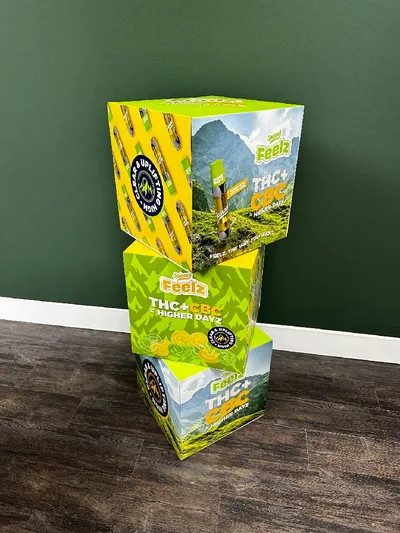
Printed corrugate cubes produced for O20. A cube looks like the simplest thing in display, and it is one of the least forgiving, because every edge is visible from two sides at once and the only thing holding the shape is the board's own structure.
What the job demanded
Corrugate is a structural material pretending to be a print substrate. Its strength runs along the flutes and almost nowhere else, so the direction the board is cut relative to the corrugation decides whether a cube holds its shape under load or slowly folds. Cubes are usually stacked or sat on, which turns that into a real question rather than an academic one. Then there is the surface: printed liner is not a smooth white sheet, and the flute structure can telegraph through as faint ribbing under heavy ink coverage. Every visible edge shows the fluted core unless it is designed out. And since these ship flat and are assembled by store staff, the folding sequence has to be obvious without an instruction sheet.
How it was produced
The cubes were printed to the board's coated liner, then cut and creased in one pass on a flatbed cutting table. The bed holds the sheet under vacuum while interchangeable tools work it: a knife follows the cut path, a crease wheel presses fold lines into the board along the flute, and tabs are cut where panels lock together. Creasing rather than scoring matters here, because a crease compresses the flute into a controlled hinge and gives a clean square corner instead of a ragged bulge. Cut lines were laid out to keep exposed flute edges away from the primary sightlines, and flute direction was set for the load the cube has to carry. The result folds from flat, locks without adhesive on site, and goes into recycling as a single material at the end of the run.