Retail
A backlit fabric lightbox for fashion retail
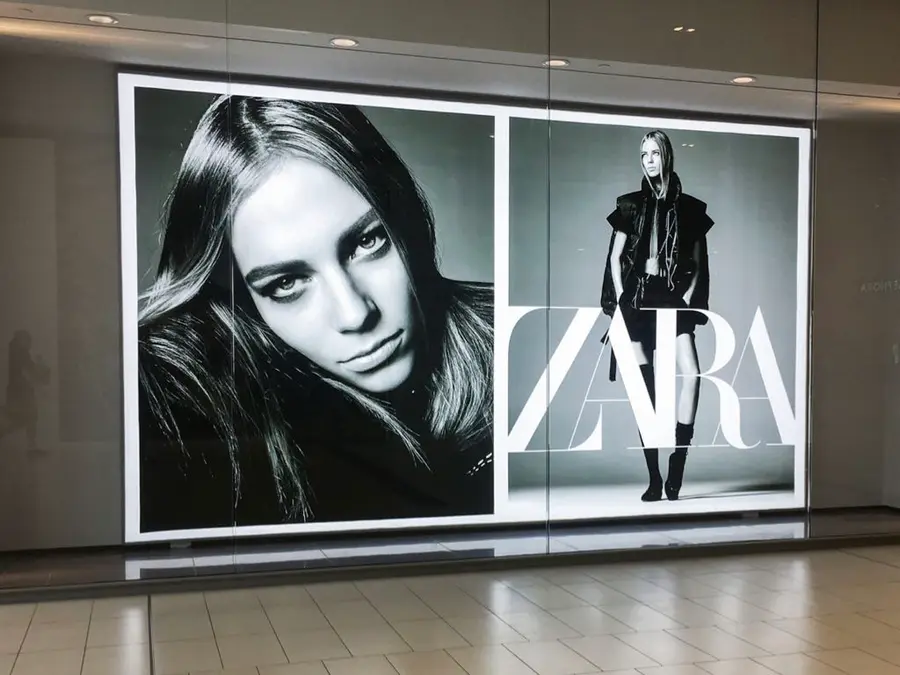
A lightbox with a backlit fabric graphic produced for Zara. Fashion retail changes its imagery faster than almost any other sector, and the graphic is nearly always a photograph, which makes both the changeover mechanism and the tonal reproduction unusually important.
What the job demanded
Fashion lightboxes carry photography, and photography is harder to reproduce under transmitted light than flat graphics are. Skin tones sit in a narrow band where small shifts read as wrong rather than merely different, and deep blacks in a backlit image tend to open up and go grey because light is coming through them. Getting density right therefore has to happen against the lit fixture, since a proof judged on a desk gives no useful information. The operational side matters just as much. Campaigns turn over frequently, faces are swapped by store staff before opening, and the outgoing graphic often needs returning. Any changeover that requires unscrewing a bezel or handling a rigid panel through a shopfront will damage something within a few cycles.
How it was produced
The face is a tensioned fabric graphic rather than a printed film panel. A silicone bead sewn around the perimeter seats into a groove in the aluminium extrusion, pulling the fabric flat across the opening so there are no ripples to catch the light, and taking the image to the frame edge so nothing crops the photograph. It fits and releases by hand, so a store team can change a campaign in minutes, and the outgoing face rolls into a tube for return. Printing was prepared to a transmitted-light density curve, with tonal separation held in the shadows so blacks stay black once illuminated, and approved lit in the fixture. Cavity depth and diffusion behind the face were set so the LED output spreads before it reaches the fabric.